
 Back
Back
The governed library and the deal room: getting approved content all the way to the buyer
Anders Haugbølle Thomsen · June 20, 2026 · 6 min read
Ask most companies whether they have good sales content and they will say yes. Ask where the current version actually lives, and the room goes quiet.
The pitch deck is somewhere. So is the one-pager, the latest case study, the pricing sheet, the security overview. The trouble is that "somewhere" usually means a rep's laptop, an old email thread, a Teams message from last quarter, and a few near-identical slides nobody can rank with any confidence. It is all approved in theory and unfindable in practice.
A governed library fixes the first half of that. Connecting it to where deals actually happen fixes the second. Both halves matter, and on its own each is worth maybe half of what the two are together.
A governed library is only as good as its reach
A single source of truth is not a new idea. The reason it so often fails is mundane: the source of truth lives in one place, and the work lives in five others.
If the approved library sits in a portal people have to remember to open, it loses. People don't leave the document they're working in to go and fetch the "right" file. They reuse whatever is closest to hand. So a library that only exists at the source gets quietly bypassed all day long.
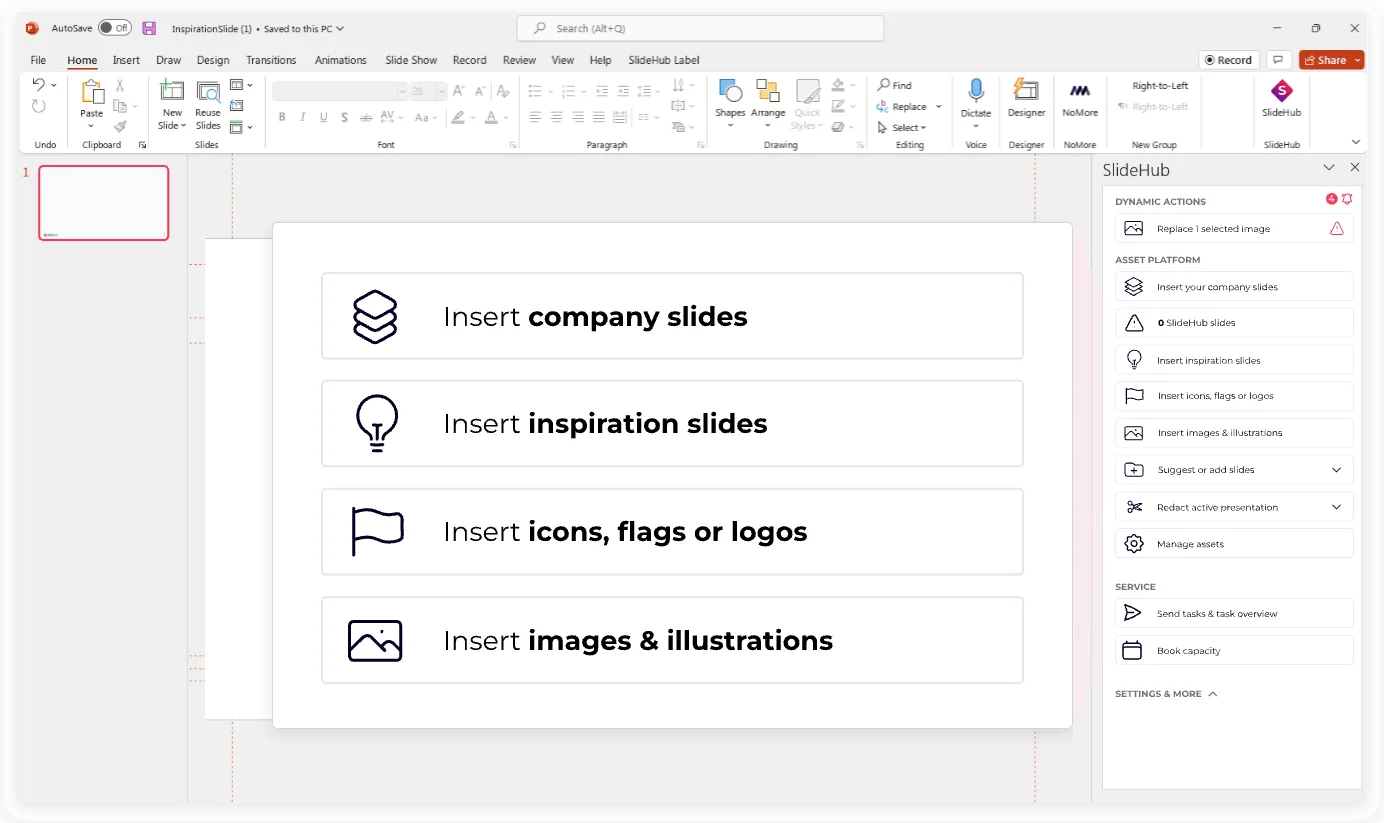
The version that works is the one that shows up inside the tools people already live in. For most organizations that's Microsoft 365. Approved slides right there in PowerPoint. Approved documents and clauses in Word. The latest template attached from inside Outlook. Everything searchable from Teams and SharePoint, and now reachable by the AI assistants people tend to ask before they ask a colleague.
That is what governance should mean in practice. Less a locked vault, more a default. When the approved version is also the convenient one, you stop having to enforce it.

The last mile of every deal is outside your walls
Most content libraries quietly stop at the company firewall. But the most important reader of your content does not work for you.
You can govern every slide your team touches and still lose control at the moment it matters most: when a deck or a proposal leaves the building and lands in front of a buyer. You have probably watched how this goes. A rep downloads "the deck," tweaks a number, attaches it to an email, and that PDF, now frozen in time and already a little out of date, becomes the thing a buying committee passes around for weeks. You don't know which version they have, whether it's current, or whether anyone read past slide four.
Connecting the governed library directly to your digital sales rooms is the same governance story, just carried the last mile to the buyer.
Native beats attached
When the deal room pulls straight from the library, the buyer is looking at the live, approved document. There is no copy sitting somewhere, slowly going stale.
Update the pricing, fix a legal clause, add a new certification to the security overview, and the deal room shows it, because it points at the source instead of a snapshot someone exported in a hurry. A rep can't accidentally send last quarter's numbers when last quarter's numbers are no longer in the library.
That one property, the right version by default, takes out a whole class of risk that teams normally manage with vigilance and a bit of luck. Compliance stops hinging on whether a salesperson grabbed the newest file. The buyer sees current, on-brand material, and you know exactly what went out.

The feedback loop is the part people miss
The right version everywhere is the safety story. The more interesting one is what you get to learn.
When content goes out as a tracked link instead of a dead attachment, you finally see what happens after you hit send: which documents buyers open, which slides hold their attention, which ones they skip past, and what your won deals tend to share that the stalled ones never do.
All of that points straight back at how the content gets built in the first place.

Most content decisions today are made on instinct. We rebuild the pitch deck because someone senior didn't like it, not because we have any real evidence about what landed. A library wired into the deal room changes the inputs. The people who own it, whether that's marketing, brand, or enablement, get a signal instead of a hunch: the case study people actually read becomes a template, and the slide nobody scrolls to gets cut. Over time the library stops being an archive and starts behaving like something that learns.
And because it's all governed at the source, acting on that signal is quick. You fix the one approved asset, and the fix shows up everywhere it's used: in PowerPoint, in the next proposal, in every deal room that references it, with nobody re-downloading a thing.
Where it compounds
The two ideas need each other.
On its own, governance is a vault nobody visits. Reach without it is just chaos at higher speed. And feedback is hard to act on when the "content" is really a thousand personal copies. Put them together, though, and they start to pull in the same direction.
Because the approved version is the convenient one, people use it. That means the buyer sees the right thing, and what the buyer does flows back to shape the next version. Since it's all governed at the source, that improvement reaches everyone at once.
Build that loop once and content stops being a pile of files you have to police. It starts doing a bit of the work for you, which is what a content library should have been doing all along.